
About the Founder
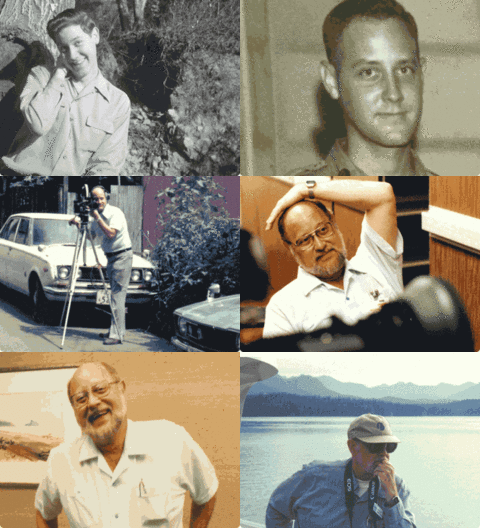
Quixote Foundation founder Arthur “Stuart” Hanisch was born into a prominent and wealthy family in 1932. Even though Stuart was very young during the Great Depression, he was uncomfortable with the contrast between his family’s affluent situation and the struggles of his peers. This intuitive response matured into a lifelong concern for fairness.
Fast-forward to the 1960s: you’ll find Stuart demonstrating to promote civil rights and serving on state and local NAACP boards. As a filmmaker he documented race-based housing discrimination, showing African Americans turned away by landlords and sellers who subsequently welcomed white folks. Stuart’s employer, the University of Wisconsin, refused to endorse the resulting film so he quit his job, ultimately taking on a wide range of social and environmental causes.
Stuart didn’t care much for the wealth he enjoyed except for when it helped him contribute to social change. He lived modestly, started Quixote Foundation in 1997, and poured money into the foundation at a rate far faster than tax benefits could accrue. He contributed his time, smarts and energy in tandem with charitable gifts, developing lifelong relationships with progressive leaders.
Stuart believed his donor’s role was secondary to nonprofit groups, saying “Money provided doesn’t deserve credit—what people and organizations do, does deserve credit.” He named the foundation after the fictitious Don Quixote in order to shift attention from himself. He loved the notion of “tilting at windmills”—charging into the fray to defend heartfelt ideals no matter how strong the resistance, whether or not others share the cause—and he supported the idealism of organizations brave enough to tilt.
When Stuart died in 2002, his son Erik became president of Quixote Foundation. Stuart gave Erik complete freedom to express his own values and decide what direction the foundation would take. Erik’s wife Lenore became executive director as well as joining the board, and together they have guided the foundation’s evolution from an anonymous, “checkbook giving” entity to an active, public institution with a full-time staff and a host ofcollaborators and advisors. Some of the changes have been dramatic, yet Quixote Foundation has continued to reflect Stuart’s passions and values. As Erik said recently, “If Stuart were still here, we probably wouldn’t have gotten to this point—and yet we couldn’t have gotten here without him.”
Want to go back farther than Stuart?
Te doy gracias, Stuart, for the chance to have a big impact!